
Does your child struggle to hold a crayon, use scissors, or manage buttons on their clothing? These everyday tasks require fine motor skills, which involve coordinating the small muscles in the hands and fingers. Children develop these skills at different rates, but ongoing difficulties with activities expected for their age may be worth discussing with a pediatrician.
Recognizing the signs of fine motor delay can help you understand where your child may need additional support. Pediatric occupational therapy can help children develop the skills they use for play, self-care, and learning. Below, we'll explain common signs, how fine motor skills develop through the preschool and elementary school years, and when to seek professional guidance.

What Are Fine Motor Skills, and What Does a Delay Mean?
Fine motor skills are the small, controlled movements children make with their hands and fingers to complete everyday tasks. A fine motor delay means a child is developing these skills more slowly than expected for their age. This may affect activities such as drawing, eating with utensils, or getting dressed independently.
Fine motor skills are different from gross motor skills, which involve larger movements such as running, jumping, and climbing. For example, picking up a small toy, holding a crayon, turning book pages, and fastening buttons all require fine motor control. Many of these activities also depend on hand-eye coordination and the ability to use both hands together.
Children develop at different rates, and struggling with one task does not necessarily mean a child has a delay. What matters is whether difficulties continue over time and affect activities that are typically expected at their age.
What Are the Signs of Fine Motor Delay in Children?
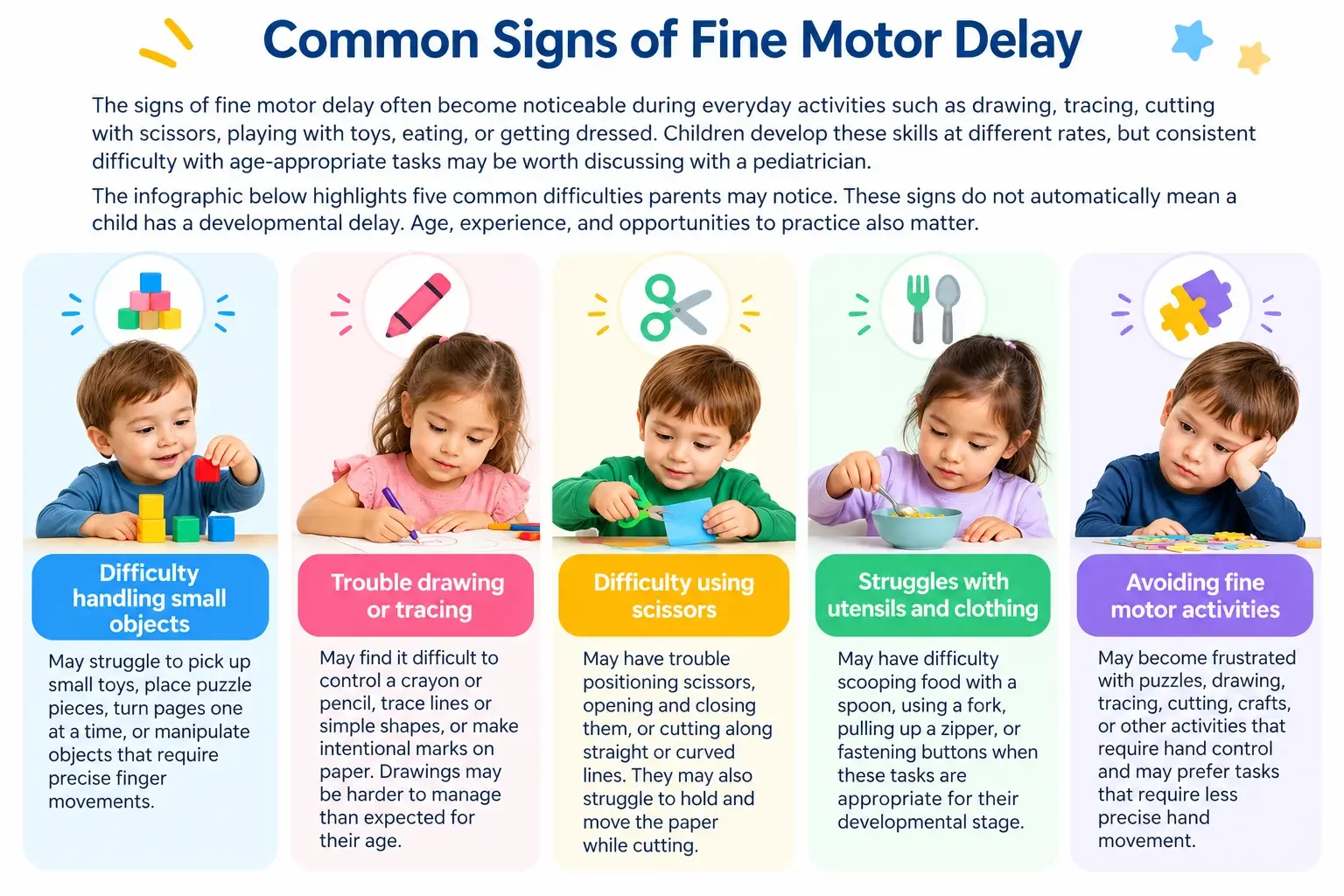
Parents may notice that their child struggles to control a crayon, trace simple shapes, cut paper with scissors, manage clothing fasteners, or handle small toys in ways expected for their age. While children develop these skills at different rates, persistent difficulty with age-appropriate tasks may be worth discussing with a pediatrician.
The infographic below highlights common signs parents may notice. These difficulties do not automatically indicate a developmental delay, as a child's age, experience, and opportunities to practice can all affect their abilities.
How Do Fine Motor Skills Develop From Preschool Through Elementary School?
Fine motor skills develop gradually as children gain better control of their hands and fingers. During the preschool years, these skills become important for eating, drawing, getting dressed, and playing. As children enter elementary school, they use them for more demanding classroom activities, including handwriting, cutting, and handling school supplies.
The Centers for Disease Control and Prevention (CDC) provides developmental milestones to help parents understand what children typically learn at different ages.
| Age | Fine Motor Developmental Milestones | What Parents May Notice |
|---|---|---|
| 2 years | Eats with a spoon, tries buttons or knobs on toys, and holds an object in one hand while using the other. | Your child may feed themselves with a spoon, experiment with toy controls, or hold a container while removing its lid. |
| 3 years | Draws a circle after being shown how, strings large beads or similar objects, and uses a fork. | Your child may copy a circle, thread large beads during play, or use a fork at mealtimes. |
| 4 years | Unbuttons some buttons and holds a crayon or pencil between their fingers and thumb rather than in a fist. | Your child may begin managing buttons on clothing and use a more controlled grip when drawing. |
| 5 years | Writes some letters in their name and buttons some buttons. | Your child may write a few recognizable letters and manage certain clothing fasteners more independently. |
These examples are based on the CDC's developmental milestone checklists for ages 2, 3, 4, and 5. CDC milestones reflect skills that at least 75% of children can do by a particular age. They are useful for tracking development but are not diagnostic tests.
Fine Motor Skills in Elementary School
As children progress through elementary school, fine motor tasks often become more complex. They may need to write longer sentences, trace or copy information, cut along shapes, and organize classroom materials with greater independence.
Some children may struggle to keep their handwriting legible, control scissors, or complete written assignments comfortably. These difficulties can become more noticeable as classroom expectations increase.
Unlike the preschool milestones listed above, these are general examples of school-related fine motor demands, not a checklist of skills every child must master at a particular age.
If your child consistently struggles with these activities or has lost skills they previously used, discuss your observations with their teacher and pediatrician. They can help determine whether further evaluation is appropriate.
Why Might a Child Have Difficulty With Fine Motor Skills?
Fine motor activities require several skills to work together. Children need to control their hand and finger movements, coordinate both hands, and use what they see to guide their actions. Difficulties in any of these areas can make tasks such as drawing, using utensils, or fastening buttons harder to manage.
For example, a child who struggles to copy a circle may have difficulty coordinating their hand movements with what they see on the paper. Another child might find opening a container challenging because they have trouble holding it steady with one hand while turning the lid with the other. Hand strength, coordination, sensory differences, and certain developmental or health conditions can also affect fine motor skills.
However, the same difficulty can have different explanations. A child who avoids coloring might find gripping crayons uncomfortable, struggle to control their movements, or simply have limited experience with drawing.
Observing these patterns can help parents identify concerns, but it does not reveal the underlying cause. A professional evaluation may be needed to better understand why a child is having difficulty.
When Should Parents Be Concerned About Fine Motor Difficulties?
It is common for children to struggle when learning a new skill. However, if your child consistently has difficulty with activities expected for their age, needs considerable help with familiar tasks, or regularly avoids activities because they find them challenging, it is worth discussing your concerns with their pediatrician.
For example, a 4-year-old who continues to struggle with drawing tools or simple clothing fasteners may need a closer look at their fine motor development. If your child loses a skill they previously had, contact their pediatrician promptly.
Before the appointment, keep a few notes about what you observe:
Activity: Which tasks does your child find difficult?
Frequency: Does the difficulty happen occasionally or almost every time?
Setting: Does the difficulty happen at home, preschool, or elementary school?
Assistance: Can your child complete the task with some help, or do they need someone to do it for them?
If your child attends preschool or elementary school, ask their teacher whether they have noticed similar challenges.
The CDC recommends discussing developmental concerns with your child's doctor and asking about developmental screening when appropriate. You do not need to wait until your child misses several milestones before raising a concern.
How Can Parents Support Fine Motor Skills at Home?
Simple activities at home can give children opportunities to practice hand control and coordination. You don't need special equipment or structured exercises. Familiar activities such as playing with dough, drawing, and getting dressed can provide useful practice.
Try Playdough for Finger and Hand Control
Encourage your child to squeeze, roll, pinch, and flatten playdough. These movements allow them to practice different finger and hand movements. Start with something simple, such as rolling a ball or pressing the dough flat, and let your child explore without worrying about the finished result.
Make Drawing and Building Part of Play
Offer age-appropriate crayons and paper so your child can scribble, draw lines, or experiment with shapes. As they become more comfortable, encourage them to trace simple lines or shapes. These activities provide opportunities to practice pencil control and hand-eye coordination.
For children ready to use scissors, try cutting paper along short, straight lines with child-safe scissors under adult supervision. This helps them practice coordinating both hands, with one hand operating the scissors and the other holding the paper steady.
Building with blocks also encourages children to practice picking up, positioning, and releasing objects. Keep these activities enjoyable and adjust the difficulty to your child's abilities rather than focusing on perfect results.
Practice Skills During Daily Routines
Getting dressed and reading together also provide opportunities to practice fine motor skills. Encourage your child to turn book pages, pull on socks, or try fastening large buttons when appropriate for their age and abilities.
Give them time to attempt the task before stepping in. If they become frustrated, offer enough help to make the activity manageable.
Always choose age-appropriate materials, supervise play, and avoid small objects that could pose a choking hazard. While home activities can encourage skill development, they do not replace professional evaluation or individualized therapy when difficulties persist.
How Can Pediatric Occupational Therapy Help With Fine Motor Difficulties?
Pediatric occupational therapy helps children develop the skills they need to participate in everyday activities. When a child has fine motor difficulties, an occupational therapist looks at how those challenges affect tasks such as drawing, cutting with scissors, getting dressed, using utensils, handwriting, and participating in preschool or elementary school activities.
Therapy begins with understanding the child's current abilities, the activities they find difficult, and the goals that matter to the child and their family. An occupational therapist may work on hand coordination, grasping and manipulating objects, using both hands together, or improving control during drawing and other activities.
For younger children, therapy often uses play-based activities such as building with blocks, handling toys, or practicing dressing skills. For school-age children, activities may focus on handwriting, managing classroom materials, and completing everyday school tasks. The approach and level of support are adjusted to each child's needs.
At A to Z Occupational & Speech Therapy, pediatric occupational therapy focuses on personalized, child-centered care. Therapists work with families to identify meaningful goals and support children's participation in daily routines, play, and learning.

Frequently Asked Questions
-
A 3-year-old may have fine motor difficulties if they consistently struggle to use a fork, copy a circle after being shown how, or string large beads. These are examples of skills commonly expected around this age. Difficulty with one task does not necessarily indicate a delay, but ongoing challenges across several activities are worth discussing with a pediatrician.
-
Possible signs include difficulty holding a crayon or pencil with the fingers and thumb rather than a fist, unbuttoning some buttons, or developing scissor skills despite opportunities to practice. Children develop these abilities at different rates, so consider how consistently your child struggles and whether the difficulties affect preschool activities or everyday routines.
-
A 5-year-old may need additional support if they consistently struggle to write some letters in their name, fasten buttons, or manage age-appropriate drawing and cutting activities. These difficulties may become more noticeable as children prepare for kindergarten or begin school. Persistent challenges that interfere with participation are worth discussing with their pediatrician.
-
Yes. A child may struggle with certain fine motor tasks without having a diagnosed developmental disorder. Limited practice, differences in coordination, or difficulty with a particular activity can affect performance. A single difficulty is not enough to determine whether a child has a developmental condition. If challenges continue or interfere with daily activities, a professional evaluation can help clarify what support may be appropriate.
-
Fine motor difficulties can occur in some autistic children, but fine motor delays alone do not indicate autism. Children can have difficulty with hand coordination or motor skills for many different reasons. Autism is identified through a broader developmental evaluation that considers social communication, behavior, and other developmental characteristics. If you have concerns about your child's overall development, speak with their pediatrician about appropriate screening.
Understanding Your Child’s Fine Motor Development
Fine motor skills help children manage everyday activities, from using utensils and playing with toys to drawing and getting dressed. While children develop these abilities at different rates, ongoing difficulties that interfere with daily routines deserve attention.
If concerns continue, share what you've noticed with your child's pediatrician. They can help determine whether further evaluation would be appropriate.
When additional support is needed, a pediatric occupational therapist can assess how fine motor difficulties affect your child's daily activities and identify skills to work on through individualized, age-appropriate occupational therapy.
